
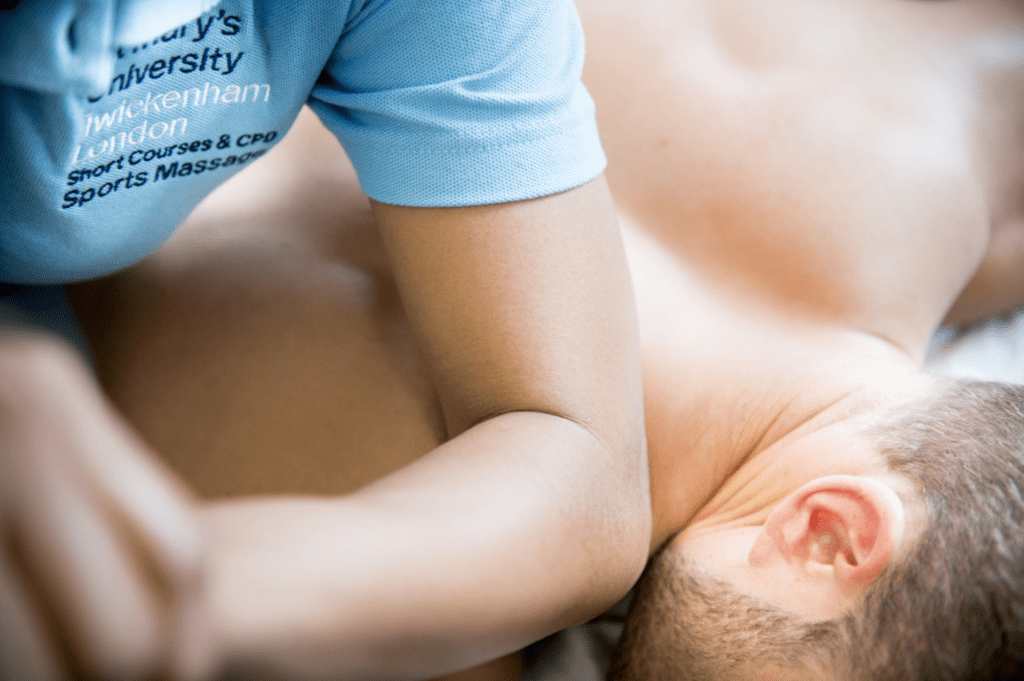
In this excerpt of Beyond the Technique, Sports Massage Tutor at St Mary’s University, Naomi Johns, emphasises the importance of being guided by your client’s unique needs during sports massage
In sports massage, technical skill is essential, but it is never the whole story.
In our training, we get taught a plethora of techniques, yet knowing how to perform a stroke does not automatically mean it should be used on every patient. Holding back is an essential part of the skillset. The most effective sports massage practitioners understand that every treatment must be guided by the individual in front of them, not by a routine, a checklist, or a textbook.
At its core, sports massage is not about ‘doing’ techniques to a body; it is about working with a patient so that they can perform to their optimum (and this includes both mentally as well as physically). This mindset is central to how we teach sports massage and to the professional standards expected of modern therapists.
Why Technique Alone is Never Enough
Sports massage training rightly places strong emphasis on anatomy, physiology, and hands-on skills. Students learn a wide range of techniques – effleurage, petrissage, frictions, trigger point work, and myofascial approaches. These tools are important, but they are only tools!
A common mistake among developing therapists is assuming that if a technique exists, it should be applied in every situation. In reality, the question should always be: is this appropriate for this patient, at this time, and for this goal?
A technically perfect deep stroke applied to the wrong tissue, at the wrong stage of healing, or without adequate patient consent can be ineffective at best and harmful at worst. Sports massage is most successful when clinical reasoning sits alongside manual skill.

The Patient, Not the Protocol
No two patients are the same. Even athletes training in the same sport may present very differently depending on training load, injury history, stress levels, recovery capacity, time in female cycle, and lifestyle factors. A protocol-based approach – where
the therapist delivers the same treatment regardless of individual presentation, fails to reflect this complexity. Working with the patient means taking the time to assess properly, listen actively, and adapt treatment accordingly. This includes understanding the patient’s goals, pain tolerance, previous experiences with massage, and any apprehension they may have about treatment.
As is a popular misconception in sports massage, pain is not a measure of effectiveness. In fact, far from it. While yes, sports massage can be uncomfortable at times, intensity should never replace intention. A treatment should empower the patient, leaving them feeling heard, supported, and confident in their recovery. This is far more valuable than a treatment that simply ‘feels deep’ and at times painful…
To read more, head over to page 20 of the recent spring edition of International Therapist
Naomi Johns is a sports massage tutor at St Mary’s University. St Mary’s University currently offers training at Level 3, 4 & 5 for Sports Massage (weekday or weekend options available), as well as Summer Intensive Programmes for Level 3, 4 & 5 Sports Massage. You can find out more information via stmarys.ac.uk/short-courses
 FHT Blog
Leave a reply