
12 May 2024
Herman Fenton advanced stretches for therapists one-day workshop
What a brilliant one-day workshop with Herman.
We had a very full day of fun facts, techniques and practice at this first ever workshop with Herman. It was a great learning experience, where we learnt how to effectively stretch groups of muscles to release muscle tension.
“Working with our own body resistance to get the best stretch from our muscles in a shorter, more time-efficient way. We stretched the whole body and learned how to do this with a partner and on our own in various positions—standing, lying, or sitting—to accommodate patients’ abilities.”
We all finished off the day with a vast amount of knowledge, our minds buzzing with future possibilities, and an eagerness to put into practice what we had learned.
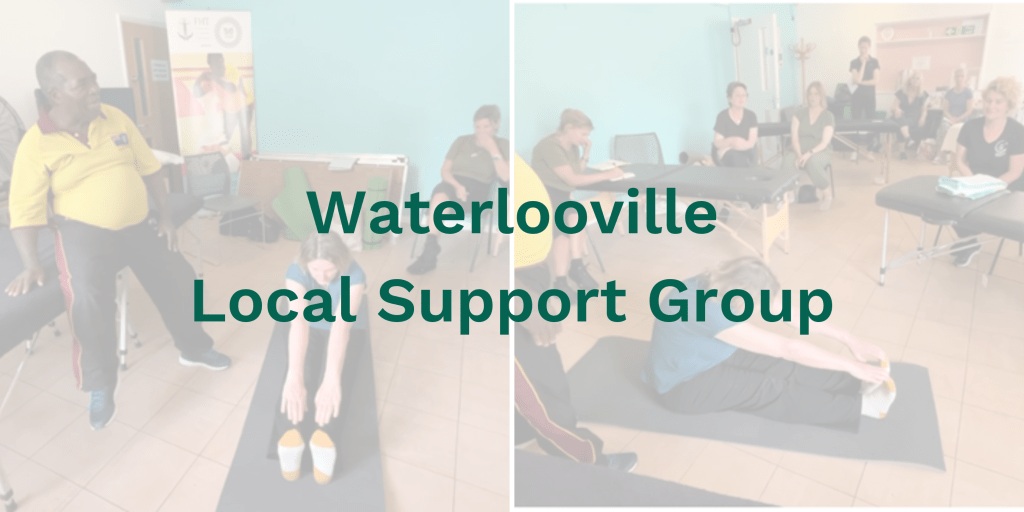
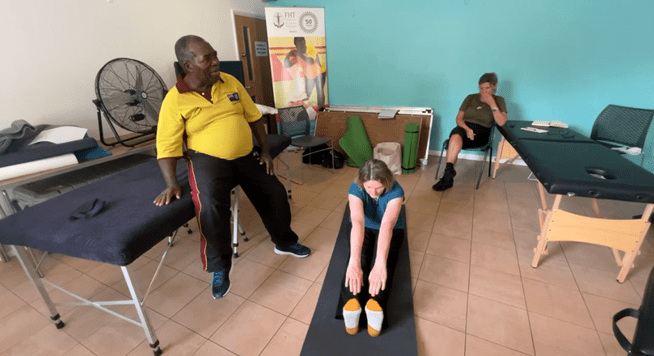
How far can you reach? Pre treatment I really tried but could only get this far.
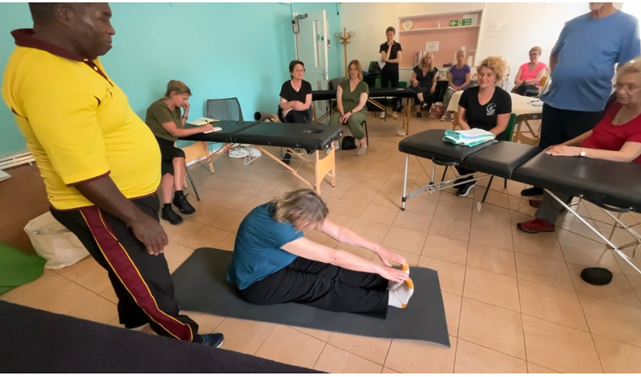
Post treatment… now look at me go!
A bit about the man himself:
Herman says, “I am a qualified sports, remedial, and complementary therapist who runs a by-appointment-only visiting practice with a diverse patient base that includes babies, children, and adults from all walks of life, including nurses, farmers, armed forces personnel, and professional and amateur sportsmen and women.”
Herman has had extensive experience, gained while treating teams of top athletes and having been headhunted from his army days. He is German-trained and a worldwide-respected sports therapist. He is a sportsman at heart and has competed in many disciplines: athletics, fencing, and rugby, to name but a few.
He started his sports therapy work while in HM Forces in the 70s and 80s. The army supported this, as he was such an asset to his fellow troops in keeping them in top shape, but he did need to use his leave to complete his training! He returned to the UK in 1991 to formalise these learned therapies. In 1994, one year before he left the army, he was competing in a fencing competition where he treated a ‘civilian’ who had sustained an injury, only to later realise he had actually treated a member of the British fencing team! His journey rocketed from there as he went on to the World Championships in Athens as a sports therapist.
The word soon got around that he had left the services, started his own practice, and was willing to travel. Before long, he was getting bookings from various sports clubs and individuals in the UK and abroad. The beauty of having gone to local, national, and international competitions while he was in the army meant that his name was—and still is—being passed on from person to person, club to club, and country to country.
Much of his work today can be traced back to the people he either treated or worked alongside at those earlier competitions. Herman says, “I will still get a call from, say, an Australian I worked on at a world championship back in 1994, saying we’re flying into London on such and such a day for a competition in Edinburgh, Birmingham, etc. If we stay overnight, could you come over and treat us before we head up to Scotland, or after we finish before we fly out? If I have the time, I will travel to treat them, as this keeps your name out there and people remember.”
“Over the years, I have continued to learn new therapies so that I can mix and match these in my treatments to suit the needs of the patients,” Herman says. “I’ve found that kinesiology works particularly well with sports therapy. It gives me a better understanding of the muscle balancing work I’m doing and allows me to continually test the muscles I’m working on so that I can adapt the treatment if necessary.”
“I’m also qualified in reflexology, massage in pregnancy, diet and nutrition, and botanical and mineral therapy. I have learnt all of these and more and use them to enhance my sports treatment and rarely use them on a stand-alone basis. For instance, I would not do a whole reflexology routine on a patient, but I might incorporate some of the reflexes into my treatment if I think it could help. If I felt a full reflexology treatment was more appropriate, I would refer the patient to a reflexologist. This is why networking is important.”
“Other than my private practice, there are a couple of other avenues I have tried since leaving the army that I decided weren’t for me. Early on, I accepted a job as a sports therapist at a clinic on Harley Street, but I found that my contract and working in one location were restrictive and didn’t suit my personality. I also couldn’t justify the amount of money I was being asked to charge patients.”
“I have also worked as a part-time sports therapy lecturer at two colleges, but as much as I loved working with the students, I wasn’t happy with the limited number of contact hours and all the politics and bureaucracy involved. I have also run my own school and, more recently, started to offer private training. This is usually one-day workshops aimed at qualified therapists, students, and chiropractors, teaching them quick assessments, releases, and stretching techniques.”
“To this day, I still enjoy being challenged and working with different patient groups.”
To get in touch with Herman:
Contact: 0203 2864 028
herminator@stonehengetherapies.com
You do not have to be a member of the FHT to attend LSG meetings. To find out more about the association, visit the FHT website at www.fht.org.uk or call 0844875 2022.
For more meeting information telephone or email our Coordinators:
Angela Pavlovic | 07748385744 | apavlovic40@icloud.com
Wendy Wyatt | 07881463485 | wendy@wendwyatt.co.uk
 FHT Blog
Leave a reply