
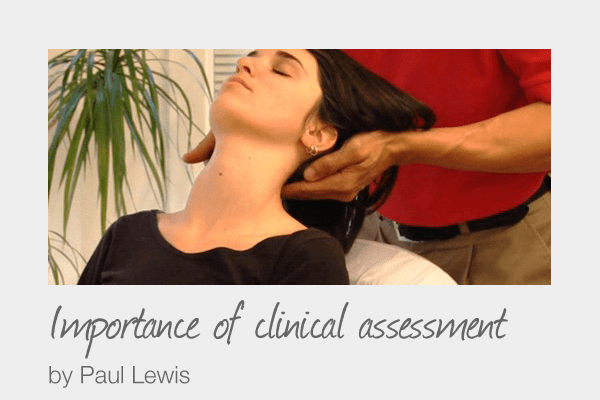
Is there room in our treatment plan for clinical assessment? To answer this question, perhaps we can ask ourselves what the purpose of clinical assessment is.
When a patient comes to see you for a treatment, you must first determine where to treat, what to treat and the techniques you are going to use to help with their presenting issues. In this context, the purpose of clinical assessment is to aid in finding the cause of the client’s dysfunction. In short, we want to find the cause/source and treat that cause – not just the symptoms that the patient presents with.
Regardless of whether you perform seated massage, sports therapy or advanced massage therapy, assessment is vital to confirming your hypothesis and to providing a rationale for the choice of modalities and treatment techniques that you will employ. When a client presents with an issue or an injury, it is necessary to look not only at the area of referred pain, but also at related structures that may indirectly contribute to their symptoms or underlying cause of injury. The cause could be skeletal, muscular or neurological, or a combination of the three. There are so many conditions that we cannot prevent. However, within the massage therapist’s scope of practice, we can maintain, rehabilitate and augment physical function in a person who is rendered dysfunctional by a condition.
We should keep in mind that, whereas doctors diagnose and we, as therapists, assess. We evaluate musculoskeletal structures to determine what has occurred and which areas are involved. This important step will allow us to create a targeted treatment strategy that embodies our plan of action. Assessment starts when you first see the client and should not end after they tell you that “my back hurts” or “I have numbness in my fingers”.
The assessment process includes various steps such as: history taking; observations; muscle tests; neurological test; palpation; and functional tests. You may not use all of these steps but this template will allow the therapist to progress through the assessment in a logical manner and arrive at an educated conclusion. This template can be used to assess any part of the body. Depending on the presenting issue of the client, the assessment could take less than 5 minutes, or it could be longer.
I believe that if you can determine where the client’s discomfort is stemming from, you can then determine the position to start their treatment in, the specific modalities to use and the areas best treated to help resolve their issues. Successful physical assessment leads to effective and thorough treatment planning and resolution of your client’s pain and/or dysfunction, and results in happy, healthy clients and a thriving practice.
FHT Member and Accredited provider, Paul Lewis, offers various advanced workshops on massage, clinical assessment and seated massage:
London
8 November
Newcastle
9 November
10 November
Isle of Wight
16 February
17 February
18 February
Glasgow
For more information about Paul, visit www.paullewis.ca
Image: Paul Lewis


Leave a reply