
Written by Amanda Oswald – Pain Care Clinic

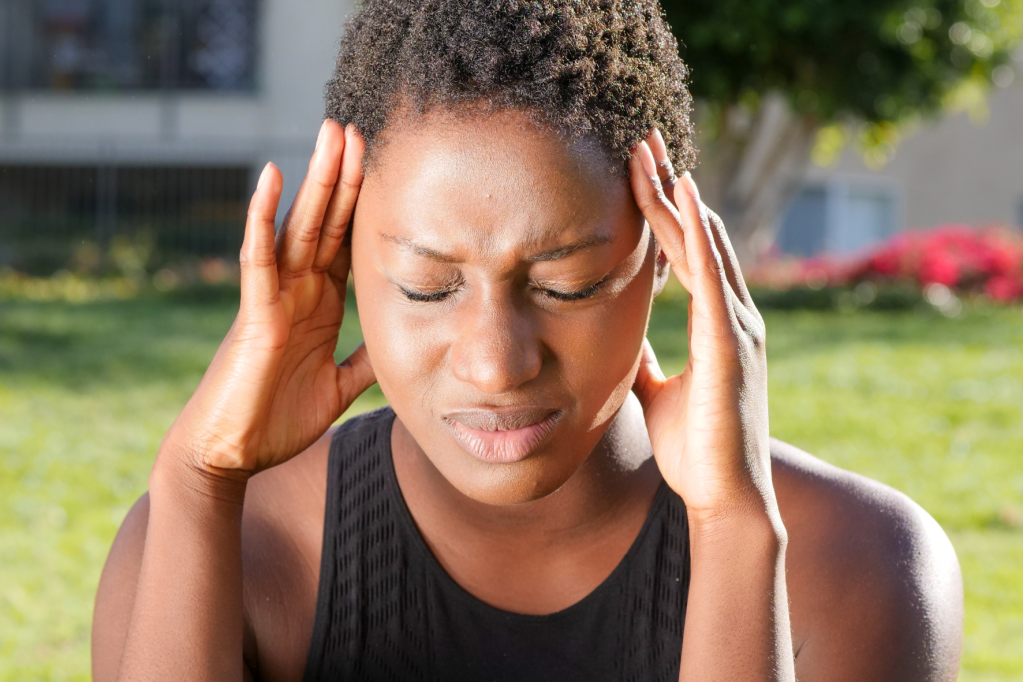
There are several hundred different types of headaches, but there are five very common types where tension in the fascia is a significant factor: migraines, tension headaches, cluster headaches, NDPH and now long-Covid headaches.
Many people tend to think of migraines as being distinct from headaches, but they are a type of headache – often with other associated symptoms. Pain is generally part of the symptom pattern, but not always, and is generally felt in the face and neck as a throbbing sensation. Many people also experience other symptoms including sensitivity to light and sound, nausea, auras or distorted vision. However, for some people, their migraines are ‘silent’, where they have other symptoms but no pain.
Tension headaches are experienced as pressure which can be felt as a tight band round the head, or a build-up of pressure behind the nose or eyes. This is often described as a sensation of your head ‘about to explode’. As pressure builds, this can also develop into a dull throbbing pain. People often develop tension headaches following a whiplash accident such as a car crash.
Cluster headaches (hence their name) appear for cluster periods of weeks or months and then disappear for a time before recurring. For many people, their cluster periods are seasonal and they can accurately predict when they will restart each year. When active, cluster headaches cause severe pain which is usually one-sided and can be accompanied by a drooping eyelid, tearing of the eye, runny nose and redness, all on the same side of the head.
New Daily Persistent Headaches (NDPH) are exactly what they say, headaches that are experienced every day. NDPH often appear often out of the blue and remain for many months with no apparent initial cause. They are often experienced by children and teenagers with debilitating migraine or tension headache-like symptoms.
Covid headaches are a new phenomenon that have appeared as a result of the Covid-19 pandemic. They are now recognised as one of the earliest signs of Covid-19 and are more common than the typical symptoms of cough, fever or loss of smell/taste. Around 15% of people with Covid-19 reported a headache as their only symptom. Covid headaches tend to be experienced on both sides of the head, with pulsing or stabbing pain, and are resistant to regular painkillers. Although Covid headaches generally last for 3-5 days, for some people they remain as a common symptom of long Covid.
There are of course many causes for headaches; these include injury, posture, diet, hormones, dehydration, stress and fatigue. However in some cases there is no clear explanation of headache symptoms and they can persist for many months or even years, severely affecting daily life.
In these cases, where there is no clear medical diagnosis, it can help to look elsewhere for the cause. As the main connective tissue in the body, fascia forms a fluid network that wraps around and through everything else. Research into this fascinating tissue system is ongoing, but it is already recognised that fascia plays an important role in body balance and movement. If the fascia is altered in any area, this can have a knock-on effect throughout the body.
Fascial restrictions can form for many reasons changing the tissue from fluid to restricted and hardened. Common causes can include injuries, surgeries which create scar tissue, natural posture, over and underuse (think computer work which requires you to sit still but overuse your hands and fingers), and stress.
For most people a combination of some or all of these can cause fascial restrictions to gradually develop over time. The body can and does adjust to accommodate restrictions as they develop but eventually they get to a point where the body runs out of options and gives you pain as a warning signal. Where the pain is felt differs from person to person, but headaches are a common outcome.
The fascial connections throughout the body mean that your headache may be coming from somewhere obvious, such as restrictions in your neck and shoulders caused by computer work, or a less obvious cause such as an appendix scar that is pulling your body forwards, or tension in your hips that is spreading up your back.
Just as fascial restrictions form gradually, so they can be gradually undone to help restore your body to more normal and pain-free balance. A good starting point is myofascial self-help exercises that can be done at home. Myofascial exercises are gentle, slow, progressive stretches and ball exercises that work at a pace that fascia responds to. They are both relaxing and effective. In our video, for the FHT Training Conference 2023, we share some simple exercises for the neck and shoulders that can help to ease tension and improve posture.
In this FHT seminar, I’ll be exploring the phenomenon of headaches and migraines in more detail – in particular the fascial causes. I’ll also be sharing some simple myofascial self-help exercises to help alleviate the symptoms.
To find out more about the FHT Conference and to watch the video, click here

 FHT Blog
Leave a reply